


Page 18 - Training of the Trainers: Integrating One Health Core Competencies for Teaching Future One Health Workforce
P. 18
1.2 Learning Outcomes in Domains of Learning
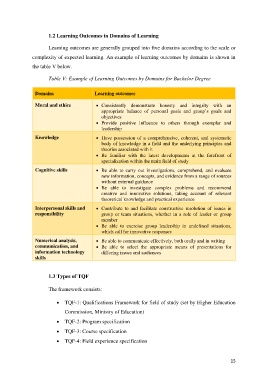
Learning outcomes are generally grouped into five domains according to the scale or
complexity of expected learning. An example of learning outcomes by domains is shown in
the table V below.
Table V: Example of Learning Outcomes by Domains for Bachelor Degree
Domains Learning outcomes
Moral and ethics Consistently demonstrate honesty and integrity with an
appropriate balance of personal goals and group’s goals and
objectives
Provide positive influence to others through exemplar and
leadership
Knowledge Have possession of a comprehensive, coherent, and systematic
body of knowledge in a field and the underlying principles and
theories associated with it
Be familiar with the latest developments at the forefront of
specialization within the main field of study
Cognitive skills Be able to carry out investigations, comprehend, and evaluate
new information, concepts, and evidence from a range of sources
without external guidance
Be able to investigate complex problems and recommend
creative and innovative solutions, taking account of relevant
theoretical knowledge and practical experience
Interpersonal skills and Contribute to and facilitate constructive resolution of issues in
responsibility group or team situations, whether in a role of leader or group
member
Be able to exercise group leadership in undefined situations,
which call for innovative responses
Numerical analysis, Be able to communicate effectively, both orally and in writing
communication, and Be able to select the appropriate means of presentations for
information technology differing issues and audiences
skills
1.3 Types of TQF
The framework consists:
TQF-1: Qualifications Framework for field of study (set by Higher Education
Commission, Ministry of Education)
TQF-2: Program specification
TQF-3: Course specification
TQF-4: Field experience specification
15

