


Page 21 - Training of the Trainers: Integrating One Health Core Competencies for Teaching Future One Health Workforce
P. 21
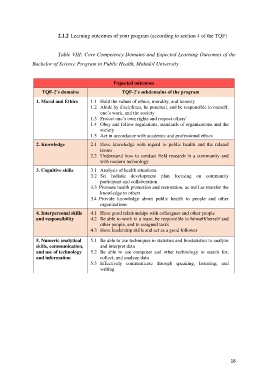
2.1.2 Learning outcomes of your program (according to section 4 of the TQF)


                              Table VIII: Core Competency Domains and Expected Learning Outcomes of the

               Bachelor of Science Program in Public Health, Mahidol University


                                                    Expected outcomes

                    TQF-2’s domains                    TQF-2’s subdomains of the program
                 1. Moral and Ethics     1.1  Hold the values of ethics, morality, and honesty
                                         1.2  Abide by disciplines, be punctual, and be responsible to oneself,
                                              one’s work, and the society
                                         1.3  Protect one’s own rights and respect others’
                                         1.4  Obey and follow regulations, standards of organizations and the
                                              society
                                         1.5  Act in accordance with academic and professional ethics
                 2. Knowledge            2.1  Have  knowledge  with  regard  to  public  health  and  the  related
                                              issues
                                         2.2  Understand how to conduct field research in a community and
                                              with modern technology
                 3. Cognitive skills     3.1  Analysis of health situations
                                         3.2  Set  holistic  development  plan  focusing  on  community
                                              participant and collaboration
                                         3.3  Promote health protection and restoration, as well as transfer the
                                              knowledge to others
                                         3.4  Provide  knowledge  about  public  health  to  people  and  other
                                              organizations
                 4. Interpersonal skills   4.1  Have good relationships with colleagues and other people
                 and responsibility      4.2  Be able to work in a team; be responsible to himself/herself and
                                              other people, and to assigned tasks
                                         4.3  Have leadership skills and act as a good follower

                 5. Numeric analytical   5.1  Be able to use techniques in statistics and biostatistics to analyze
                 skills, communication,       and interpret data
                 and use of technology   5.2  Be  able  to  use  computer  and  other  technology  to  search  for,
                 and information              collect, and analyze data
                                         5.3  Effectively  communicate  through  speaking,  listening,  and
                                              writing


                                                                                                       18

