


Page 36 - Training of the Trainers: Integrating One Health Core Competencies for Teaching Future One Health Workforce
P. 36
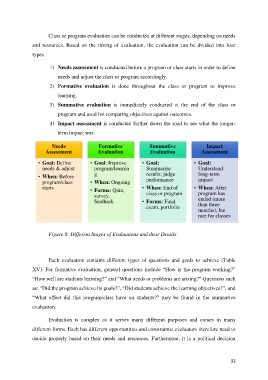
Class or program evaluation can be conducted at different stages, depending on needs

               and resources.  Based  on  the  timing  of  evaluation, the  evaluation  can  be  divided  into  four
               types.


                       1)  Needs assessment is conducted before a program or class starts in order to define
                           needs and adjust the class or program accordingly.

                       2)  Formative  evaluation  is  done  throughout  the  class  or  program  to  improve

                           learning.
                       3)  Summative  evaluation  is  immediately  conducted  at  the  end  of  the  class  or

                           program and used for comparing objectives against outcomes.
                       4)  Impact assessment is conducted further down the road to see what the longer-

                           term impact was.


                        Needs                Formative             Summative                 Impact
                     Assessment              Evaluation             Evaluation            Assessment

                  • Goal: Define         • Goal: Improve        • Goal:                • Goal:
                    needs & adjust         program/learnin        Summarize              Understand
                  • When: Before           g                      results; judge         long-term
                    program/class        • When: Ongoing          performance            impact
                    starts               • Forms: Quiz,         • When: End of         • When: After
                                           survey,                class or program       program has
                                           feedback             • Forms: Final           ended (more
                                                                  exam, portfolio        than three
                                                                                         months), but
                                                                                         rare for classes


                       Figure 8: Different Stages of Evaluations and their Details


                       Each  evaluation  contains  different  types  of  questions  and  goals  to  achieve  (Table

               XV). For formative evaluation, general questions include “How is the program working?”
               “How well are students learning?” and “What needs or problems are arising?” Questions such

               as: “Did the program achieve its goals?”, “Did students achieve the learning objectives?”, and

               “What  effect  did  this  program/class  have  on  students?”  may  be  found  in  the  summative
               evaluation.


                       Evaluation  is  complex  as  it  serves  many  different  purposes  and  comes  in  many
               different forms. Each has different opportunities and constraints; evaluators therefore need to

               decide properly based  on their  needs and  resources. Furthermore, it is  a political decision


                                                                                                       32

