


Page 34 - Training of the Trainers: Integrating One Health Core Competencies for Teaching Future One Health Workforce
P. 34
Evaluation
                                                       Decision-making

                                                     Stakeholder focused      Questions
                                                        Interest driven      Knowledge


                         Assessment                         Report                  Research
                         Measurement     Ongoing                                  New knowledge
                                                      Monitoring
                           External   Improvement                                Researcher focused
                           Feedback             Tracking (inputs & outputs)      Hypothesis-driven
                                                         Internal
                                                                                 Journal publication
                                                     Inform decisions


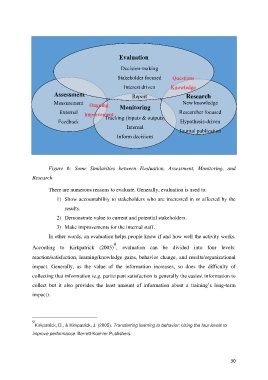
                       Figure  6:  Some  Similarities  between  Evaluation,  Assessment,  Monitoring,  and
               Research


                       There are numerous reasons to evaluate. Generally, evaluation is used to:
                          1)  Show accountability to stakeholders who are interested in or affected by the

                              results.

                          2)  Demonstrate value to current and potential stakeholders.
                          3)  Make improvements for the internal staff.

                       In other words, an evaluation helps people know if and how well the activity works.
                                                    9
               According  to  Kirkpatrick  (2005) ,  evaluation  can  be  divided  into  four  levels:
               reaction/satisfaction, learning/knowledge gains, behavior change, and results/organizational

               impact.  Generally,  as  the  value  of  the  information  increases,  so  does  the  difficulty  of

               collecting that information (e.g. participant satisfaction is generally the easiest information to
               collect  but  it  also  provides  the  least  amount  of  information  about  a  training’s  long-term

               impact).


               9
                Kirkpatrick, D., & Kirkpatrick, J. (2005). Transferring learning to behavior: Using the four levels to

               improve performance. Berrett-Koehler Publishers.


                                                                                                       30

