


Page 39 - Training of the Trainers: Integrating One Health Core Competencies for Teaching Future One Health Workforce
P. 39
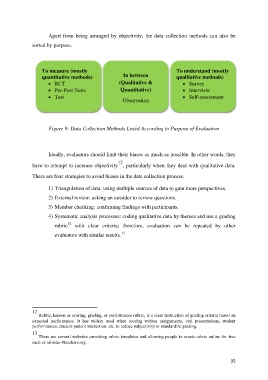
Apart from being arranged by objectivity, the data collection methods can also be
sorted by purpose.
To measure (mostly To understand (mostly
quantitative methods) In between qualitative methods)
RCT (Qualitative & Survey
Pre-Post Tests Quantitative) Interview
Test Self-assessment
Observation
Figure 9: Data Collection Methods Listed According to Purpose of Evaluation
Ideally, evaluators should limit their biases as much as possible. In other words, they
12
have to attempt to increase objectivity , particularly when they deal with qualitative data.
There are four strategies to avoid biases in the data collection process.
1) Triangulation of data: using multiple sources of data to gain more perspectives.
2) External review: asking an outsider to review questions.
3) Member checking: confirming findings with participants.
4) Systematic analysis processes: coding qualitative data by themes and use a grading
12
rubric with clear criteria; therefore, evaluation can be repeated by other
13
evaluators with similar results.
12
Rubric, known as scoring, grading, or performance rubric, is a clear instruction of grading criteria based on
expected performance. It has widely used when scoring written assignments, oral presentations, student
performances, student-patient interaction, etc. to reduce subjectivity or standardize grading.
13
There are several websites providing rubric templates and allowing people to create rubric online for free
such as rubistar.4teachers.org.
35

