


Page 37 - Training of the Trainers: Integrating One Health Core Competencies for Teaching Future One Health Workforce
P. 37
since it involves many stakeholders but within limited resources. It also needs collaboration
from respondents who may represent different perspectives. It is value-laden and therefore
has real consequences for people and programs.
2. Data Collection Methods
Methods of data collection are grouped into three different types: qualitative,
quantitative, and mixed methods.
Qualitative methods focus on answering questions of the type ‘how’ and ‘why’,
using inductive reasoning. Their descriptive answers are generally used for explaining about
experience, behaviors, and beliefs.
Quantitative methods are employed to answer questions about ‘what’, ‘how many’,
and ‘who’. Their explanatory answers are derived from deductive reasoning and usually
presented in forms of relationships, statistics, and probabilities.
Mixed methods are the combination of both qualitative and quantitative collection
methods and applied for describing and explaining. The data that evaluators collected
depends on the information they want.
11
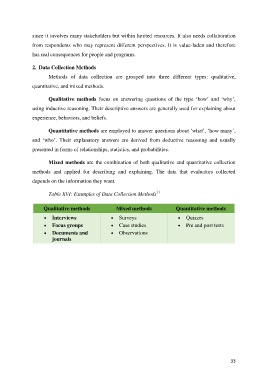
Table XVI: Examples of Data Collection Methods
Qualitative methods Mixed methods Quantitative methods
Interviews Surveys Quizzes
Focus groups Case studies Pre and post tests
Documents and Observations
journals
33

