


Page 38 - Training of the Trainers: Integrating One Health Core Competencies for Teaching Future One Health Workforce
P. 38
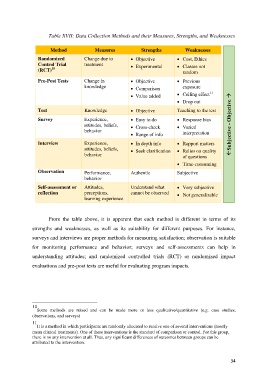
Table XVII: Data Collection Methods and their Measures, Strengths, and Weaknesses
Method Measures Strengths Weaknesses
Randomized Change due to Objective Cost, Ethics
Control Trial treatment Experimental Classes not
10
(RCT) random
Pre-Post Tests Change in Objective Previous
knowledge Comparison exposure
11
Value added Ceiling effect
Drop out
Test Knowledge Objective Teaching to the test
Survey Experience, Easy to do Response bias
attitudes, beliefs, Cross-check Varied
behavior
Range of info interpretation
Interview Experience, In depth info Rapport matters
attitudes, beliefs, Seek clarification Relies on quality
behavior of questions
Time-consuming
Observation Performance, Authentic Subjective
behavior
Self-assessment or Attitudes, Understand what Very subjective
reflection perceptions, cannot be observed Not generalizable
learning experience
From the table above, it is apparent that each method is different in terms of its
strengths and weaknesses, as well as its suitability for different purposes. For instance,
surveys and interviews are proper methods for measuring satisfaction; observation is suitable
for monitoring performance and behavior; surveys and self-assessments can help in
understanding attitudes; and randomized controlled trials (RCT) or randomized impact
evaluations and pre-post tests are useful for evaluating program impacts.
10
Some methods are mixed and can be made more or less qualitative/quantitative (e.g. case studies,
observations, and surveys)
11
It is a method in which participants are randomly allocated to receive one of several interventions (mostly
mean clinical treatments). One of these interventions is the standard of comparison or control. For this group,
there is no any intervention at all. Thus, any significant differences of outcomes between groups can be
attributed to the intervention.
34

