


Page 44 - Training of the Trainers: Integrating One Health Core Competencies for Teaching Future One Health Workforce
P. 44
Exercise on Analyzing Forms of Evaluation
                        Regardless of data collection methods, each type of evaluation has different forms/tools

                 with  particular  strengths  and  weaknesses.  Evaluators  should  choose  the  right  form(s)  for  their

                 evaluation. While pre-post tests can help evaluators attribute change in knowledge to a particular

                 course or intervention, they need to be designed carefully to ensure they are valid measures of
                 knowledge  change.  As  the  questions  below  illustrate,  there  are  many  limitations  to  pre  and
                 posttests as evaluations of knowledge change.


                 1. Pre-Post Test to understand change in leadership knowledge

                 Pre-Test:                                   Post-Test:
                 Team members should share vision, ______,   Team members should share vision, ______,
                 responsibility, accountability and credit among   responsibility, accountability and credit among
                 collaborators.                              collaborators.
                 A- Power                                    A- Power
                 B- Meals                                    B- Meals
                 C- Money                                    C- Money
                 D- Emails                                   D- Emails


                 2. Post student reflection/Self-assessment to understand change in leadership
                   OHCC Domain         Proficiency before workshop       Proficiency after workshop

                      Leadership                 __ None                          __ None
                                                 __ Low                           __ Low
                                                 __ Medium                        __ Medium
                                                 __ High                          __ High


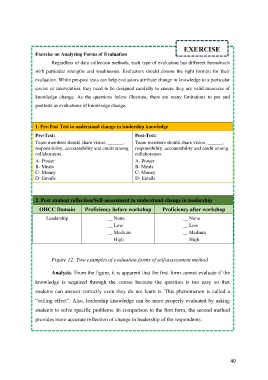
                        Figure 12: Two examples of evaluation forms of self-assessment method


                        Analysis: From the figure, it is apparent that the first form cannot evaluate if the
                 knowledge  is  acquired  through  the  course  because  the  question  is  too  easy  so  that

                 students  can  answer  correctly  even  they  do  not  learn  it.  This  phenomenon  is  called  a
                 “ceiling effect”. Also, leadership knowledge can be more properly evaluated by asking

                 students to solve specific problems. In comparison to the first form, the second method

                 provides more accurate reflection of change in leadership of the respondents.


                                                                                                       40

