


Page 42 - Training of the Trainers: Integrating One Health Core Competencies for Teaching Future One Health Workforce
P. 42
EXERCISE

                 Exercise on data triangulation
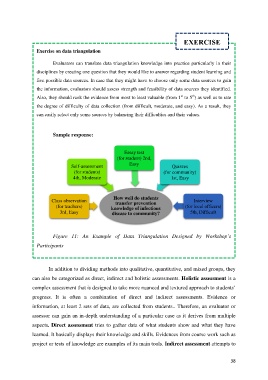
                         Evaluators can translate data triangulation knowledge into practice particularly in their

                 disciplines by creating one question that they would like to answer regarding student learning and

                 five possible data sources. In case that they might have to choose only some data sources to gain
                  the information, evaluators should assess strength and feasibility of data sources they identified.

                                                                                      th
                                                                                 st
                 Also, they should rank the evidence from most to least valuable (from 1  to 5 ) as well as to rate

                 the degree of difficulty of data collection (from difficult, moderate, and easy). As a result, they
                  can easily select only some sources by balancing their difficulties and their values.


                         Sample response:


                                                        Essay test
                                                     (for student) 2nd,
                                 Self-assessment          Easy               Quizzes
                                  (for students)                          (for community)
                                  4th, Moderate                              1st, Easy


                                                   How well do students
                        Class observation                                              Interview
                          (for teachers)            transfer prevention            (for local officers)
                            3rd, Easy             knowledge of infectious             5th, Difficult
                                                   disease to community?


                         Figure  11:  An  Example  of  Data  Triangulation  Designed  by  Workshop’s

                 Participants


                       In addition to dividing methods into qualitative, quantitative, and mixed groups, they

               can also be categorized as direct, indirect and holistic assessments. Holistic assessment is a

               complex assessment that is designed to take more nuanced and textured approach to students’
               progress.  It  is  often  a  combination  of  direct  and  indirect  assessments.  Evidence  or

               information, at least 2 sets of data, are collected from students.. Therefore, an evaluator or

               assessor can gain an in-depth understanding of a particular case as it derives from multiple

               aspects. Direct assessment tries to gather data of what students show and what they have

               learned. It basically displays their knowledge and skills. Evidences from course work such as
               project or tests of knowledge are examples of its main tools. Indirect assessment attempts to


                                                                                                       38

