


Page 45 - Training of the Trainers: Integrating One Health Core Competencies for Teaching Future One Health Workforce
P. 45
3. Evaluation Planning

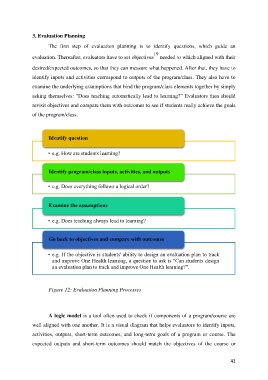
                       The  first  step  of  evaluation  planning  is  to  identify  questions,  which  guide  an
                                                                     19
               evaluation. Thereafter, evaluators have to set objectives  needed to which aligned with their

               desired/expected outcomes, so that they can measure what happened. After that, they have to
               identify inputs and activities correspond to outputs of the program/class. They also have to

               examine the underlying assumptions that bind the program/class elements together by simply

               asking themselves: “Does teaching automatically lead to learning?” Evaluators then should
               revisit objectives and compare them with outcomes to see if students really achieve the goals

               of the program/class.


                       Identify question


                      • e.g. How are students learning?


                       Identify program/class inputs, activities, and outputs


                      • e.g. Does everything follows a logical order?


                       Examine the assumptions


                      • e.g. Does teaching always lead to learning?


                       Go back to objectives and compare with outcomes


                      • e.g. If the objective is students' ability to design an evaluation plan to track
                        and improve One Health learning, a question to ask is "Can students design
                        an evaluation plan to track and improve One Health learning?".


                       Figure 12: Evaluation Planning Processes


                       A logic model is a tool often used to check if components of a program/course are

               well aligned with one another. It is a visual diagram that helps evaluators to identify inputs,

               activities,  outputs,  short-term  outcomes,  and  long-term  goals  of  a  program  or  course.  The
               expected  outputs  and  short-term  outcomes  should  match  the  objectives  of  the  course  or


                                                                                                       41

